A full-size elephant is not an easy thing to carve. Add a deadline, and a client who wants it built in sections that fit together without a visible join, and a basic three axis machine starts to struggle.
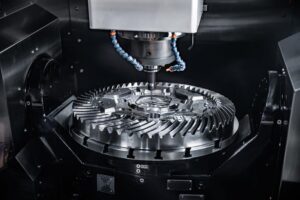
That is where 5 axis CNC machining earns its place in a model maker’s factory. The cutting tool can reach a shape from almost any angle, so large models, patterns and complex parts can be cut from one piece of material with fewer stops and fewer chances for error.
At JH May, we have used it to machine patterns for a product launch, a set of Vespa patterns that went from machine to vacuum formed parts within 12 days, and a full-scale art and furniture piece cut in several sections. Every job started the same way, with a 3D file and a block of material.
This guide explains what 5 axis CNC machining is, how it differs from 3+2 machining, and where it helps most in model making. It also covers the materials we cut, the mistakes that add cost, and how to prepare a project so it runs smoothly from the first quote.
What 5 Axis CNC Machining Actually Does
A standard CNC mill moves the cutting tool in three directions: left and right, forwards and back, and up and down. That is enough for flat shapes and shallow relief, such as a landscape for an architectural model.
A 5 axis machine adds two rotating movements. The tool, or the table holding the material, can tilt and turn. This lets the cutter lean in and reach the sides, curves and hollows of a shape without anyone unclamping the part and turning it by hand.
The result is a smoother, more accurate surface on complex forms, and often a shorter route from file to finished part.
3+2 or Full 5 Axis?
You will see two terms when you compare 5 axis CNC milling services.
- 3+2 machining. The machine tilts the part to a set angle and locks it. The cutter then works with the usual three movements. It repeats this for each face.
- Full (simultaneous) 5 axis. All five movements happen while the tool is cutting. This gives flowing, sculpted surfaces with no step marks between angles.
Most work does not need full simultaneous movement. One moulding specialist estimates that 5 axis machines run in 3+2 mode for 80 percent or more of their time. Full 5 axis earns its keep on freeform shapes such as a sculpted bust, a car body panel or a curved pattern.
Good machine shops choose the method for the shape, not for the sales brochure.
Why Model Makers Rely on 5 Axis Machining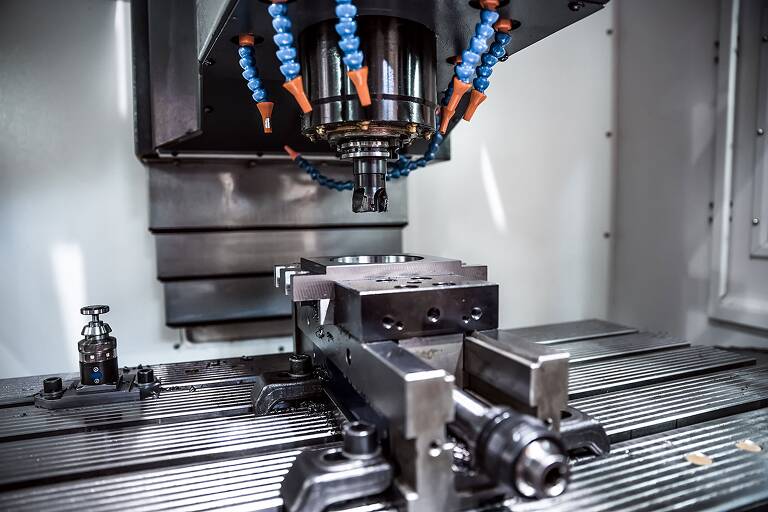
Fewer setups is the main benefit. Every time a part is unclamped and repositioned, a small error can creep in. On a large model made of several sections, small errors show up as gaps, steps or panels that will not line up.
Machining several faces in one setup keeps every face tied to the same starting point. Our aluminium manifold is a good example. It was machined from a solid block, with multiple faces cut in the same setup. That saves lead time and keeps the faces accurate to one another.
5 axis machining also handles undercuts. These are features that sit underneath an overhang, where a straight-down tool cannot reach. For a pattern or a model with deep curves, this is often the deciding factor.
Cutting complex shapes from one piece of material has a practical bonus too. There are fewer joins to fill and sand, so the finishing team starts with a cleaner surface.
What We Machine: Patterns, Moulds and Full-Scale Models
Our large 5-axis machining service covers three main kinds of work.
- Patterns. These are the master shapes used to make fibreglass or composite mouldings, vacuum formed parts, polyurethane vacuum mouldings and reaction injection mouldings.
- Large models. These include display pieces, sculpture and art that are too big or too curved to build any other way.
- Complex parts. These range from machined metal components to detailed model parts.
Here are three real examples.
Snoopy patterns. We machined the patterns from the client’s approved 3D CAD data. Multiple GRP models were then produced and paint finished for a product launch and ongoing point of sale.
Vespa patterns. These were milled in high density model board from client data and modified for vacuum forming. The 5 axis machining and vacuum forming took place within 12 days.
Full-scale elephant. This art and furniture project was machined in several sections from high density model board, on both 3 axis and 5 axis machines.
We cut from a wide range of materials, including aluminium, tooling board, carbon fibre and high density model board. Foams and plastics suit large, light models, while aluminium suits parts that need strength.
From 3D File to Finished Model
A 5 axis machine only moves as well as the file that drives it. The usual route looks like this:
- Get a 3D model. Many clients send their own CAD data. If you only have drawings or a sketch, our designers can build the model in SolidWorks.
- Plan the cut. We use Delcam PowerShape and PowerMill software to plan toolpaths. For very large models, the software splits the shape into smaller sections that the machine can handle.
- Machine the material. Rough cuts remove the bulk first, then fine passes bring out the detail.
- Finish. Sections are joined and our paint shop applies the final finish.
If the object already exists, such as an old sculpture or a prototype with no drawings, laser scanning can capture its shape and give us a file to work from.
Finishing deserves planning from day one. A machine can cut a very accurate shape, but it does not paint it. Allow time for that stage when you set a deadline.
3 Axis, 5 Axis or Robot: Choosing the Right Machine
The cheapest machine is the one that suits the shape. For shallow relief with no undercuts, such as a site model with gentle slopes, 3 axis milling is often all you need. Makers of large pattern routers say the same: shallow 3D patterns without undercuts can be cut on three axes.
5 axis machining comes into its own when a shape has deep curves, overhangs, or faces on several sides. It is also the better choice when sections of a large model must meet exactly.
For the biggest and most sculptural pieces, we also have a 7-axis robot that mills large models and sculptures. We use it for work such as a bust or a statue.
Our factory has 12 CNC milling machines across 3, 4 and 5 axes, so we can match each job to the right one. You do not have to guess which you need. Send us the file or the brief and we will say what suits it.
Four Mistakes That Add Time and Cost
Asking for full 5 axis when 3+2 will do. Simultaneous movement means longer programming. If your shape does not need smooth sculpted surfaces, say so and ask for the quicker option.
Sending drawings but no 3D file. 5 axis machining needs a 3D model. If you do not have one, tell us at the start so the design time is part of the quote.
Leaving finish until last. Paint, texture and assembly take time. Tell us the finish you want when you brief us, because it can change how we cut and split the model.
Changing the design after the cut starts. Large models in tooling board are quick to machine but cannot be put back once cut. Agree the file before machining begins. Our guide on commissioning a model covers what to settle early.
Bring Us the Shape Nobody Else Will Cut
5 axis CNC machining lets a tool reach almost any part of a shape in one setup. For model makers, that means fewer errors, cleaner surfaces and large pieces that fit together.
The main points to remember:
- 3+2 suits most jobs. Full 5 axis suits sculpted, flowing shapes.
- Fewer setups keep every face accurate to the others.
- Patterns, large models and complex parts all benefit.
- A good 3D file, and a plan for finishing, save the most time.
JH May has made models since 1919, and the family is still involved. Our 10,000 sq ft factory in Ongar, Essex has the machines, the designers and the paint shop under one roof. If you have a shape in mind, contact our team or call 01277 365500. For a look at how our machining has developed, read our piece on the evolution of CNC in model making.