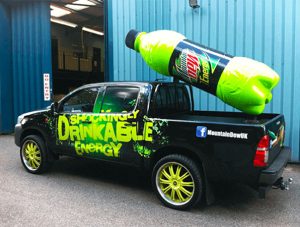
Picture a four-metre Champagne bottle catching the light at a luxury launch in Mayfair, or a towering, branded beer can rising over the crowd at Reading Festival. In an attention economy ruled by the scrolling thumb, drinks brands are increasingly turning to physical scale as a way to cut through. Giant replicas have become one of the most powerful tools in the brand activation playbook, blending out-of-home impact, social media virality and on-trade visibility in a single asset.
This guide is written for marketing, brand and event teams at UK drinks businesses who are considering oversized replicas as part of their activation mix. It covers why they work, how spirits, Champagne and beer brands each approach them differently, what goes into building one, and the practical questions every brand team should ask before commissioning.
Why Giant Replicas Work for Drinks Brands
Scale is, quite simply, a pattern interrupt. In a world saturated with screens, a physical object several times life size disrupts the visual landscape and demands attention. For drinks brands, this matters more than for almost any other category, because drinks packaging is already iconic. A Champagne bottle silhouette, the curve of a Coca-Cola contour, the shape of a Hendrick’s apothecary bottle: these are visual shorthand for the brand itself. Scaled up, they become unmissable.
There is also a content multiplier effect. A well-designed giant prop becomes a photo opportunity, generating thousands of organic social posts at a single major event. That earned media often delivers a stronger return than the equivalent paid digital spend, particularly when amortised across multiple activations.
The execution, however, varies sharply by category. Spirits, Champagne and beer each demand a different approach, and getting the brief right starts with understanding why.
Spirits, Champagne and Beer: Three Categories, Three Approaches
Spirits: Craft, Heritage and Premium Detail
Spirits brands, particularly in the premiumisation era, live or die by perceived craft. A giant whisky, gin or tequila bottle replica must read as authentic at every distance. Label fidelity, foil work, embossed glass effects and the realism of the closure all matter. A bespoke build is almost always the right route here, rather than an off-the-shelf approach.
Common deployments include distillery visitor centres, brand homes, trade shows such as Imbibe Live and ProWein, and on-trade activations. JH May’s own Grouse Whisky bottle case study is a good example of the level of detail expected: scaled-up bottles that hold up to close inspection, not just distant viewing.
Champagne and Prestige Cuvées: Elegance and Theatre
Champagne and prestige cuvées take a different route. The replicas tend to be more modest in scale but considerably higher in finish quality. Hand-applied gold leaf, foil capsule detailing, illuminated bases and hand-painted label artwork are common. The artwork fabrication and finishing process is where these projects are won or lost.
Typical settings include luxury launches, awards ceremonies, hospitality suites, travel retail and high-end seasonal activations. Think jewellery box rather than spectacle: smaller, but flawless.
Beer: Spectacle, Scale and Sampling
Beer briefs lean the other way. Festival activations, sports sponsorship and outdoor sampling demand scale, robustness and weather resistance. Giant inflatable cans, oversized kegs and towering bottles function as wayfinding, photo backdrops and sampling stations all at once. The finish bar is still high, but the brief is engineered around durability, repeat deployment and rapid set-up rather than gallery-grade detail.
Materials and Fabrication
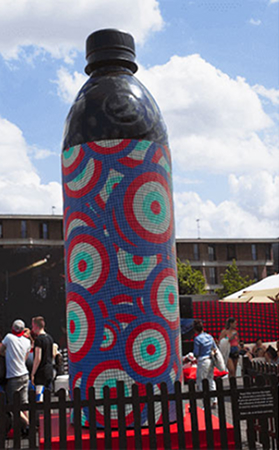
The right material depends on use case, environment and reuse expectations. Most giant drinks replicas are built using one or more of the following:
- Fibreglass (GRP) is the workhorse for premium, durable, repeat-use builds. It takes paint and finishing beautifully and stands up to outdoor conditions when properly sealed. JH May’s GRP moulding capability sits behind most high-end bottle replicas of this type.
- High-density foam (EPS or PU) is lightweight and cost-efficient for indoor display, often CNC-routed from digital files for precision.
- Vacuum-formed plastics offer a sensible middle ground for medium production runs.
- Inflatables are unbeatable for rapid deployment, festival tours and shipping economics, though finish detail is limited compared with hard-shell builds.
- Rotomoulded plastics suit robust, repeat-use tour assets.
Large-format 3D printing is increasingly used for prototypes and mid-scale components, particularly for complex closures, embossed details and feature elements that would be slow to sculpt by hand. The finish itself, regardless of substrate, is largely determined by the paint shop, where Pantone matching, metallic effects and protective coatings turn a fabricated shape into a believable brand asset.
From Brief to Build: How the Process Works
A typical design and make project for a drinks brand follows a structured sequence: creative brief and reference gathering, scaled technical drawings, material specification, prototyping where required, fabrication, finishing, transport, installation and post-event storage or refurbishment.
The single biggest determinant of quality is how early the fabricator is involved. Briefs that arrive with the artwork, scale and venue already locked down without technical input frequently run into problems: weight loadings that won’t pass venue rigging checks, label artwork that distorts at scale, or finishes that won’t survive the third deployment. An end-to-end fabricator who can challenge the brief at the start, rather than execute it blindly, protects both the budget and the brand.
Practical Considerations Drinks Brands Often Overlook
Lead Times
Bespoke fibreglass builds typically need eight to sixteen weeks from approved brief to delivery. Inflatables and simpler builds can be turned around in three to six. Brands that approach fabricators four weeks before a major activation often end up compromising on finish, scale or both.
Reuse and Cost-Per-Activation
A giant replica should be designed for reuse from the outset. A £25,000 hand-finished bottle deployed once is expensive. The same asset deployed across five activations over three years, with planned refurbishment between bookings, becomes one of the most cost-efficient line items in the marketing budget. Modular construction, durable substrates and serviceable finishes are what make this possible.
UK Compliance
Designs and placements must align with the Portman Group Code, the ASA and the CAP Code. Particular care is needed around anything that could be considered child-appeal, and around placement near schools and family venues. A drinks-sector-experienced fabricator will flag these issues at the design stage rather than after production.
Sustainability
Recyclable materials, modular builds and a defined end-of-life plan are increasingly written into client RFPs. Fabricators who can speak to circularity, reuse and responsible disposal are now at a meaningful commercial advantage.
Where Giant Replicas Earn Their Keep
The most common deployments for drinks-brand replicas in the UK include trade shows and B2B exhibitions, music festivals, sports sponsorship activations, on-trade pop-ups, distillery and brand-home installations, travel retail and duty-free, Christmas markets, and city-centre PR launches.
Categories driving the strongest demand right now include Scotch whisky, premium gin, Champagne and prestige cuvées, beer, and the booming tequila and no-and-low alcohol categories.
A Quick Checklist for Marketing Teams
Before commissioning a giant replica, brand teams should be able to answer the following:
What is the venue, sightline and audience? Will the asset be reused, and if so, how many times? Indoor, outdoor or both? What finish standard does the brand demand? Who owns storage and logistics between deployments? Does the design comply with UK alcohol marketing rules? Each answer materially affects the brief, the budget and the build.
Getting Your Giant Replica Right
Giant replicas, done well, are strategic brand assets that deliver standout visibility, social-media reach and long-term ROI across multiple activations. Spirits demand craft and heritage detail. Champagne demands elegance and finish. Beer demands spectacle, scale and durability. The brands getting it right are those treating their replicas as reusable, compliance-aware, sustainably built assets rather than one-off props, and who involve their fabricator early enough to shape the brief rather than just execute it.
If you have an upcoming activation, brand-home installation or trade-show centrepiece in mind, JH May’s team is happy to talk it through. Have a look at our case studies or get in touch to discuss your brief.
Frequently Asked Questions
How much does a giant bottle replica cost?
Costs vary widely depending on size, material and finish. A simple inflatable can start at a few thousand pounds, while a premium hand-finished fibreglass bottle for a spirits or Champagne brand typically runs from £15,000 upwards. Reuse across multiple activations significantly improves cost-per-event.
How long does it take to produce a giant replica?
Bespoke fibreglass builds usually require eight to sixteen weeks from brief to delivery. Inflatables and simpler builds can be produced in three to six weeks. Lead time depends on scale, finish standard and approval cycles.
Can giant replicas be used outdoors?
Yes, provided they are built for it. Fibreglass and rotomoulded plastic are well suited to outdoor use, with UV-stable finishes and weather-rated construction essential for festivals, sports venues and seasonal markets.
Are giant replicas reusable?
They should be, and they should be designed that way from the start. Modular construction, durable materials, planned refurbishment and proper storage allow a single asset to be deployed across multiple activations over several years.
Do giant replicas need to comply with UK alcohol marketing rules?
Yes. Designs and placements must align with the Portman Group Code, the ASA and the CAP Code, particularly around child appeal and proximity to schools or family venues. An experienced drinks-sector fabricator will flag these considerations at the design stage.