There is a great deal of enthusiasm in manufacturing and product development circles about what artificial intelligence can now do for the prototyping process. AI-assisted design software, generative modelling tools, and automated CNC programming are all moving quickly, and the pace of change is genuinely significant.
But alongside the enthusiasm, a quieter and more important conversation is taking place. Because for all the capability that AI brings to the early stages of product development, the physical prototype, the object you can hold, test, stress, and present, still requires something that no algorithm can fully replicate. It requires craft, judgement, and the kind of practical expertise that only comes from years of working with real materials.
This article looks honestly at where AI is adding genuine value to the prototyping and model making process, where its limitations become apparent, and why the role of the skilled model maker has not diminished. If anything, it has become more important.
What AI Is Actually Doing in Prototyping Today
AI is making an impact across several stages of the product development process, and it is worth being specific about where and how.
Accelerating the Design and Iteration Phase
Generative design tools can now produce multiple geometry options from a set of engineering constraints. Feed a system the load requirements, material properties, and dimensional limits for a component, and it can generate dozens of viable structural forms that a human engineer might never have considered. This compresses the early ideation phase considerably.
For teams working on rapid prototyping projects, this has real practical value. Getting from concept to a set of testable geometries faster means more iterations are possible within the same budget and timeline.
Automating Repetitive CNC Programming Tasks
AI-assisted CAM software is improving the speed and efficiency of CNC machining programming. Toolpath generation, which once required an experienced programmer to work through each operation manually, can now be partially automated for standard geometries and materials. For high-volume or repeat work, this reduces lead times.
Supporting 3D Scanning and Reverse Engineering
AI algorithms are increasingly embedded in 3D scanning workflows, helping to clean up point cloud data, identify surface anomalies, and generate cleaner mesh outputs from complex physical objects. For reverse engineering work, this speeds up the process of converting a physical part into an accurate CAD model.
Helping Teams Communicate Concepts Earlier
AI-generated visualisations and renderings allow clients and engineering teams to explore and stress-test a concept before any physical work begins. This is genuinely useful for alignment, especially on complex bespoke model making projects where the brief is still evolving.
Where AI Falls Short in Physical Prototyping
Understanding the genuine limitations of AI in this context matters, because the risks of over-reliance are real and sometimes costly.
AI Cannot Assess Physical Reality
A generative design tool can produce a geometry that satisfies its input constraints perfectly on screen. It cannot tell you how that geometry will behave when machined from a specific billet, how the surface will respond to a particular paint finishing process, or whether the wall thickness is realistic given the manufacturing method intended.
Physical prototyping is full of decisions that require hands-on experience of materials and processes. When producing mechanical models or functional assemblies, the difference between a component that works and one that fails in testing often comes down to knowledge that exists in the hands of the person making it, not in any dataset.
It Cannot Weigh the Tradeoffs That Matter to a Client
A skilled model maker working on an architectural model does not simply execute a brief. They interpret it. They consider how the model will be used, who will handle it, how it will be transported, and what it needs to communicate to its audience. They make dozens of small decisions along the way that serve the client’s real purpose, not just the stated specification.
AI tools optimise for the parameters you give them. They cannot read between the lines of a brief, understand the context behind a request, or apply the kind of tacit professional judgement that turns a good model into an exceptional one.
The Polished Render Is Not the Prototype
One specific risk worth naming: AI-generated visualisations and photorealistic renders can look extraordinarily convincing. This is useful, but it can also create a false sense of progress. A render tells you nothing about weight, surface texture, structural integrity, or how the object feels to hold. Clients who mistake a polished visualisation for a validated prototype can find themselves surprised when the physical object reveals problems the screen never showed.
The physical product model remains the only reliable test of whether a concept actually works in the real world.
AI Lacks Contextual Knowledge of Specialist Processes
Many prototyping projects involve specialist manufacturing processes that require deep contextual knowledge. Vacuum casting, GRP moulding, complex paint finishing, large-scale fabrication: these are disciplines where the variables are numerous and the margin for error is small. AI tools trained on general datasets do not carry the accumulated process knowledge that an experienced workshop develops over decades.
What This Means for the Model Maker’s Role
The arrival of AI tools has not made the skilled model maker redundant. The evidence, both from the industry and from the broader history of manufacturing technology, points in the opposite direction.
Craft Becomes the Differentiator
As AI makes the early stages of design exploration faster and more accessible, the quality of the physical output becomes a more significant point of distinction. When concept generation is easier, the bar for what the finished prototype must achieve rises. Clients expect more, and rightly so.
At JH May, the investment in technology has always sat alongside investment in skilled people. The design and make process we use combines the speed benefits of CNC and digital tooling with the judgement and finish quality that only experienced model makers can apply. That combination is what clients return for.
The Model Maker Becomes an Interpreter of AI Outputs
One of the more practical shifts happening in workshops that use AI tools is that the model maker increasingly acts as a critical filter for what the technology produces. Generative design outputs need to be assessed for manufacturability. AI-assisted toolpaths need to be reviewed by someone who understands how a specific machine behaves with a specific material.
This is a more skilled role, not a less skilled one. The ability to evaluate, refine, and improve upon what AI generates requires deep domain knowledge. It is not a task that can be delegated back to the algorithm.
Bespoke Work Remains Entirely Human-Led
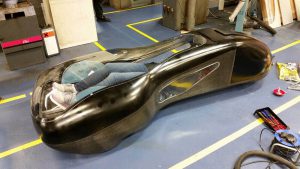
There is a category of work where AI assistance is minimal and human expertise is everything. Highly bespoke commissions, complex articulating assemblies, hand-finished exhibition pieces, large-scale sculptural work: these are projects where the model maker’s individual skill and experience is the product. No generative tool is going to replace the judgement required to hand-finish a complex surface, or the experience required to engineer an articulating mechanism that performs reliably across hundreds of cycles.
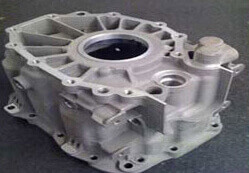
You can see examples of this kind of work in our case studies, which include everything from prototype automotive gearboxes to large-scale architectural competition models.
How to Use AI in Your Prototyping Process Without Losing Quality
For product teams and engineers working on physical development projects, a few principles help get the most from AI tools whilst protecting the quality of the output.
Use AI for exploration, not finalisation. Generative design and AI-assisted rendering are powerful tools for exploring the problem space quickly. Treat them as a way of generating options to evaluate, not as a route to a finished specification.
Engage your model maker early. The earlier an experienced model maker is involved in a project, the more effectively they can guide the design towards something that is both physically achievable and optimally made. Bringing in the workshop only at the point of manufacture is a common and costly mistake.
Validate concepts physically as early as possible. A concept that looks right in a render needs to be tested in physical form before significant development resource is committed. Even a lower-fidelity physical model will reveal things about a concept that no screen-based tool can.
Do not mistake visual fidelity for technical validation. AI-generated visualisations are useful for communication and alignment. They are not a substitute for the testing and validation that physical scale models and functional prototypes provide.
Choose the right manufacturing process for the stage of development. Early-stage concepts may be best served by fast, lower-cost methods. As the design matures, processes like large-format 3D printing or precision CNC machining become appropriate. A skilled prototyping partner will help you match the process to the stage.

AI Is a Tool. Judgement Is the Work.
AI is a genuine and useful addition to the prototyping toolkit. It accelerates parts of the process that used to consume significant time, opens up design options that would previously have been impractical to explore, and helps teams move from concept to physical test more efficiently.
But it does not understand materials. It does not carry the practical knowledge of how a surface will machine, how a joint will hold, or how a model needs to behave in the hands of the person who will use it. It cannot interpret a brief, read a client’s real priorities, or make the hundreds of small professional judgements that determine whether a prototype is merely adequate or genuinely excellent.
The best prototyping work has always combined the best available technology with the best available craft. That is exactly the position JH May has held for over 90 years, and it is exactly where we remain. Explore our full range of model making and prototyping services to find out how we can support your next project.