
A 5 metre model of plane, flying through the sky at Farnborough International Air Show.
Customers often come to us to combine traditional models with digital projection technologies; these techniques can create interactive, informative displays straight out of a science-fiction film. Not only does the use of movement and colour draw a potential customer’s eye to the display, interactive 3D models can show how your product will function without it needing to be overtly explained, and will leave them talking about the experience in future meetings.
Recently, we were tasked by the team at Ouno Creative to design and create a model of an aeroplane. This model would be used as part of their plans for an interactive design experience within the GKN Aerospace Pavilion at Farnborough Air Show.
The model, combined with advanced projection technology, would create an engaging 3D presentation; the display was to showcase the model flying through a range of weather conditions and covered in various animated graphical treatments, illustrating GKN’s products and capabilities. The plane, half of a passenger jet from nose to tail, was scaled to be 5 metres long with a wingspan of over 2.2m. It was to be the only hi-tech projection experience at the Air show, which hosted over 100,000 visitors last time it was in town.
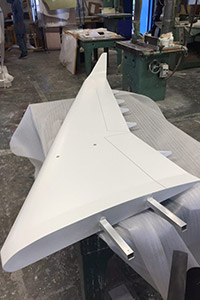
How we created the 3D model plane
We designed the aircraft, as well as the support structure and wall mount, simultaneously; we knew it would be difficult to affix the model to the wall whilst hiding the join, so our custom-made bracket worked by sliding directly into the aluminium frame inlayed into the model. The frame, designed to be lightweight while supporting the length of the plane’s wing, allowed the model to hang on the wall without any external support.
The fuselage, wing and engine were machined from model board; this material was chosen because it machines well, while also being light enough to hang from a wall without issue. The fuselage was manufactured in three parts, with a recess machined in the front face for the wing and the back for the frame. The wing was machined from the same material,with wing tips, the engine and the plane’s tail fin being manufactured from a lightweight version of model board. Once assembled, the model was painted and transported to the site.
Once onsite, we had to affix our custom-made bracket to the wall; this had to be precisely placed to allow the visuals to line up, and perfectly flush to the wall, to give the appearance of the plane protruding from the background without leaving any noticeable seams or gaps. Once the bracket was up we lifted the plane onto it, which then sat perfectly in place on the bracket.
Next came the audio-visual team at Drive,who used projection mapping software and 9 separate projectors to overlay content, even wrapping it to the protruding wing and making the engine look like it was spinning. As well as the 3D visual display, the team also used high quality surround-sound audio to produce an immersive experience for viewers. The finished effect was stunning, and showed the client’s products in a way that is certain to capture the imagination of the industry professionals viewing the display; it definitely educated us to what could be achieved with a model, some projectors and hard work!
You can watch the YouTube video here.