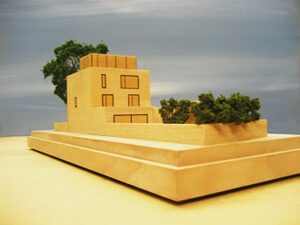
In this series of blogs, we will focus on how we use advances in manufacturing processes to aid the creation of models and prototypes that would have previously been completely handcrafted. Using computer-assisted tools and design technologies can help us manufacture the most complex items from a wide range of materials, all faster than it would have been possible to carve by hand. The first in this series is on architectural models and how we utilise different manufacturing techniques to make them surpass our client’s expectations.
Technology advances manufacturing in all industries. Items that were difficult to manufacture become easier over time, and computerised design and manufacturing leads to less mistakes (human error). This saves a project time and money when manufacturing, whether you’re working in low volume or high. Mistakes (or trial and error manufacturing) cause delays, whereas working with CAD software allows engineers to check how an item will perform before manufacturing begins. Similarly, CNC engineering allows items to be milled to a fraction of a millimetre, leading to products being created with a high level of precision and repeatability. This style of high precision manufacturing is perfect for small batch production, such as prototypes or technologically advanced models.
One of the main ways we’ve updated the manufacturing process for one of our main products is to revolutionise the methods with which we manufacture architectural models. Traditionally, architectural models were presented in either – 2D drawings, Time consuming handmade models or Simple wooden or foam block models; these would be scaled down from design drawings and cut out using traditional saw and sanding combinations. These could only really be used to manufacture simple designs, whereas utilising technological methods allows complex 3 dimensional shapes to be printed or milled with a high level of precision.
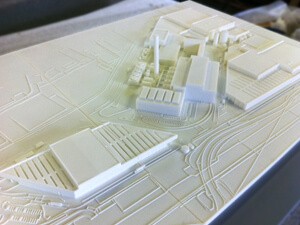
CNC Milling with our 5-axis machine allows complex shapes to be milled out of a single piece of material, allowing architectural models to be cut with precision. We’ve used this technique to design complex scaled architectural models from acrylic and ureol, as well as designing and manufacturing bases for models that echo the terrain of the proposed build. Similarly, 3D printing or rapid prototyping allows components or the entire model to be built layer by layer; this can create hollow shapes or complex interwoven designs easily, which would be time consuming to manufacture by hand. Milling leaves the finished product the same colour as whatever material was used, which can then be polished, primed or painted by our expert model makers, and modern 3D printing techniques leave a monochromatic model in a wide range of colours that can also be painted.
Translating CAD information to a file that can be 3D printed is considerably faster than scaling an architectural model using traditional methods; as well this increase in speed, the level of detail and the accuracy of complex shapes that can be produced allows revolutionary architectural designs to be modeled precisely.
The level of detail that can be achieved from 3D printing can be beneficial for helping the client visualise the project, with accurate scale models allowing the viewer to see how the finished building would look amongst the surroundings. While a rough architectural model may only outline the size and shape of the finished building, a 3D printed model can exhibit a level of detail that can amaze clients, as well as being a useful practical tool for architects and contractors. We’ve used SLA and SLS 3D printing to create complex designs including removable floors and design features, as well as creating flowing architectural designs built from a single piece of material. The 3D printing technology can also be used to mass produce components in a model that would be time consuming to manufacture by hand; if you were to design a housing complex, and several models of houses were to be repeated multiple times, 3D printing would allow these parts to be repeated perfectly, quickly and cost effectively.
To save model-building time, and to create high quality and lightweight models that are perfect representations of your design, take advantage of modern manufacturing techniques like 3D printing. For examples of how we’ve utilised all available technologies to manufacture high quality architectural models, view our case study page. Or if you would like more information on what we can achieve with modern technology, get in touch with us by email at [email protected] or phone us on 01277 365500 for a quotation or a discussion.