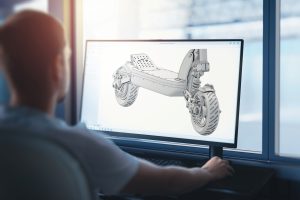
CAD (Computer Aided Design) and CAM (Computer Aided Manufacture) have helped to revolutionize the design, modelling and manufacturing industry allowing computer generated models to be created and then manufactured which are defined by specific geometrical parameters as used by the designer.
In the case of CAD the model will firstly appear on the computer screen as a three-dimensional diagram representing the part, or the system of different parts which can be easily and quickly amended by simply altering the relevant parameters. This allows designers to view the objects with a variety of parameters and representations and to test the objects in simulated conditions.
When it comes to CAM this geometrically designed data is sent to computer automated machinery for production of the item.
When using CAD the designer can simulate all movements of a part or prototype throughout the production process in three dimensions, the whole process simulating angles, speeds, feed rates etc plus any other potential constraints which would limit the optimization and operation of the machine.
CAD and CAM systems have brought together the designers, the manufacturers and any other processes involved in getting a product from the imagination to the market place which is of particular importance for companies who work together on such projects. A firm which contracts a partner in either the design or manufacture of a particular product can greatly benefit from this technology.
CAD enables the designer to make changes quickly and easily without the time consuming and potential inaccuracies involved in the old erasing then redrawing when designing with rulers, compasses and squares. The computer generated 3D models can also be rotated on an axis simulating the designer actually turning the model in their hands to see it from all different angles.
CAD/CAM has allowed designed and model making companies to produce accurate scaled models quickly, cost effectively and accurately.